Introduction
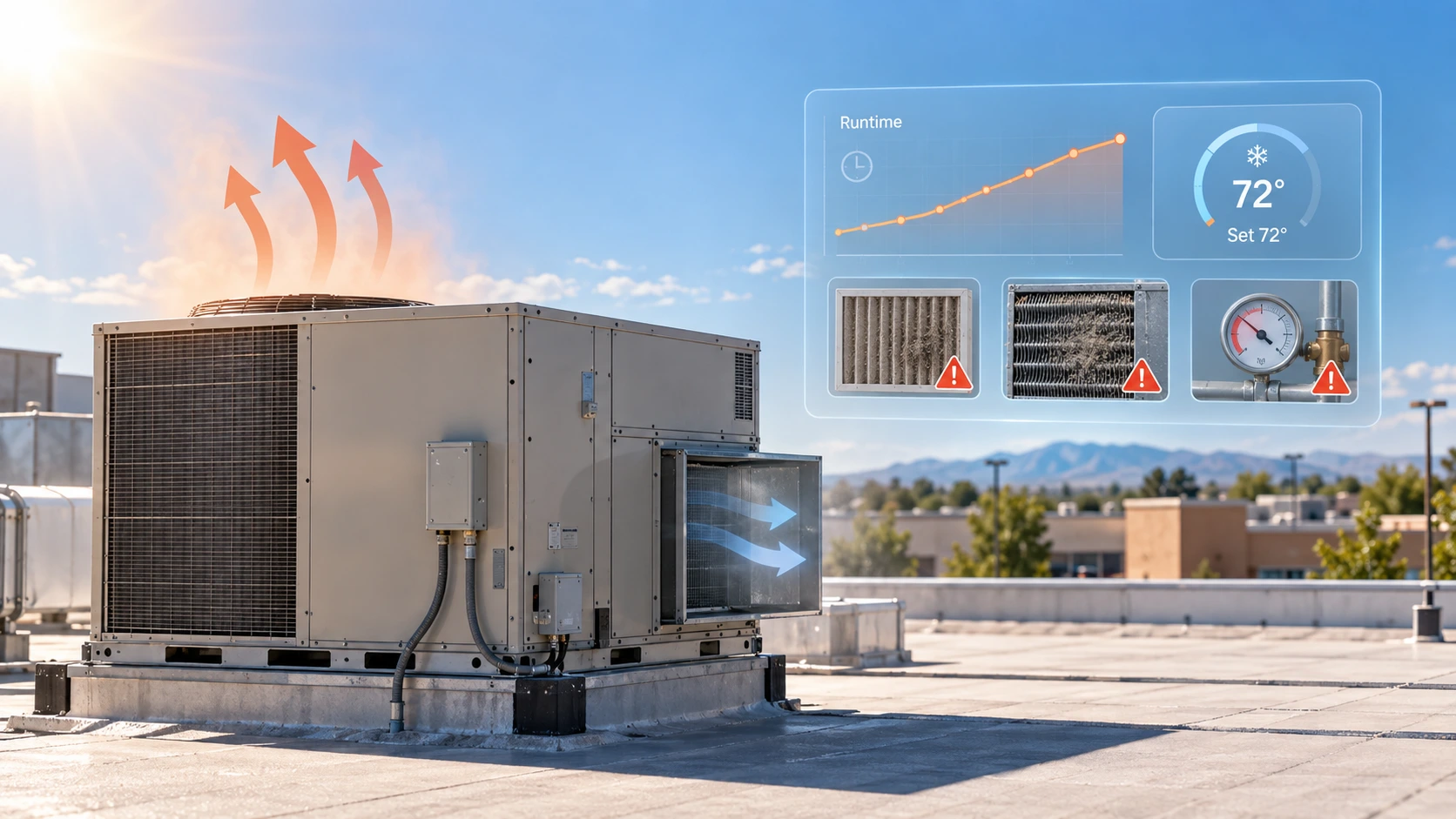
An air conditioner that runs constantly has stopped being able to reach setpoint. On a rooftop unit, the usual cause is lost cooling capacity: dirty air filters, a fouled condenser coil, low refrigerant charge, or a thermostat calling incorrectly. The earliest reliable signal is run time climbing while outdoor temperature stays flat.
Summary: How Do You Know If a Rooftop Unit Is Losing Cooling Capacity?
An air conditioner running continuously usually indicates it cannot reach the target temperature. The most common causes include:
- Dirty air filters: Block airflow and reduce cooling efficiency.
- Low refrigerant levels: Cause longer run times and inefficient cooling.
- Incorrect thermostat settings: Can make the unit run non-stop even when cooling cycles should stop.
- Restricted airflow: Blocked ducts or vents increase run times and reduce cooling.
- Frozen evaporator coils: Block airflow and stop cooling.
- Oversized or undersized units: An air conditioning unit can run continuously if it is oversized or undersized for the space.
- High outdoor temperatures: Increase the cooling load on the system.
Addressing these issues can help restore normal operation and prevent unnecessary wear or energy costs.
Why does my AC run constantly but the building still feels warm?
This usually indicates the air conditioner can no longer deliver enough cool air for the load. Common causes are a fouled condenser coil, low refrigerant charge, dirty air filters restricting airflow, or failing compressor valves. If the AC runs constantly and the space is still blowing warm air, the unit has already lost enough capacity that run-time data would have flagged it weeks earlier.
How Do You Know If a Rooftop Unit Is Losing Cooling Capacity?
A rooftop unit losing cooling capacity runs longer to reach the same setpoint. The earliest reliable signal is compressor run time climbing while outdoor temperature stays flat, followed by slower recovery after night setback and a widening gap between setpoint and actual temperature on hot afternoons. The space still feels fine, which is why capacity loss usually goes unnoticed until peak load exposes it.
Recognizing Capacity Loss
Faults like this are not a niche problem. Lawrence Berkeley National Laboratory estimates that HVAC system and control faults account for an average of 29% of commercial building energy use, equivalent to roughly 4% to 5% of total US energy consumption.
What does it mean when a rooftop unit loses capacity?
Capacity is how much heat a unit can move in a given amount of time. A rooftop unit rated for a certain tonnage when it was commissioned will move less heat as components wear, refrigerant charge drifts, and coils foul.
The unit does not announce this. It compensates. It runs longer, cycles differently, and keeps hitting setpoint right up until the day conditions demand more than it can deliver.
That compensation is the whole problem. From inside the building, a unit at 80% capacity and a unit at 100% capacity feel identical on a mild day. The difference only appears on the hottest afternoon of the year, which is also the worst possible time to discover it.
What are the early signs of capacity loss?
| Sign | Description |
| Run time climbing at stable outdoor temperature | The clearest signal available, and the one that appears first. |
| Longer recovery after night setback | A unit that used to reach setpoint by 7:00 a.m. now gets there at 7:40. |
| More frequent cycling or near-continuous operation | The unit cycles more often or runs almost constantly. |
| Widening gap between setpoint and actual on hot afternoons | The unit runs continuously and never satisfies. |
| Higher supply air temperature | The unit delivers warmer air than it used to. |
| Rising energy use | Increased energy use attributable to that unit with no change in schedule or occupancy. |
| Rule out the cheap causes first: dirty air filters, a thermostat calling incorrectly, or a slipping blower belt. These are quick to check on any air conditioning system and quick to eliminate, and none of them explain a decline that has been building for weeks. |
Individually, any of these could be a schedule change or a warm week. Together, and trending in the same direction over several weeks, they describe a unit in decline.
Understanding these early signs helps you identify when to take action, which we discuss in the next section.
Simple Troubleshooting Steps
Simple troubleshooting involves checking the basics on-site, but remote visibility from an integrated energy management system makes it easier to see which units are actually underperforming.
- Air filters
- Thermostat settings in multi-site operations such as convenience store energy management systems
- Airflow (ducts and vents), which is especially critical in convenience store energy management where door openings and case loads vary all day
Why does capacity loss stay hidden until summer?
Because most of the year, a degraded unit is still oversized for the load.
Commercial rooftop units are typically specified for design conditions, meaning the hottest expected day. On a 78°F afternoon in May, a unit that has lost 20% of its capacity still has more than enough to hold the space. It just runs longer to do it, and nobody is watching run time.
Then the first 105°F day arrives, the load exceeds what the unit can still deliver, the space climbs, and it presents as a sudden failure. It was not sudden. It was a slow decline that finally met a condition it could not meet.
This seasonal pattern means that regular monitoring and maintenance are essential to catch problems before peak demand exposes them, particularly for retail energy management systems that supervise many rooftop units across multiple stores.
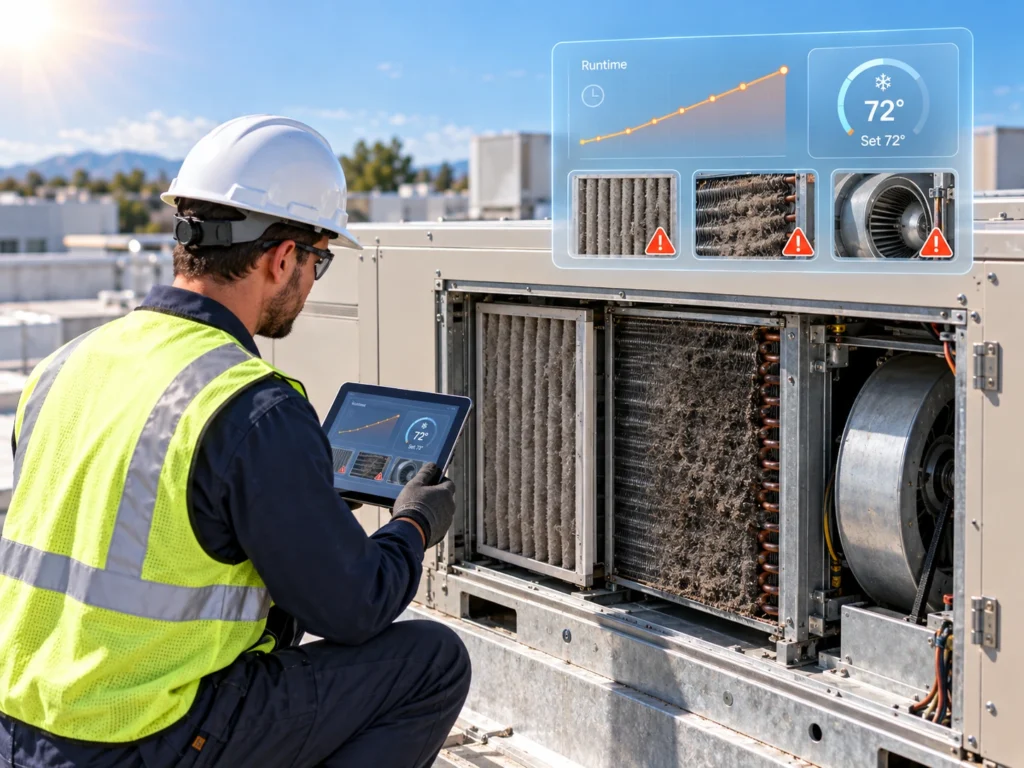
What causes a rooftop unit to lose cooling capacity, such as dirty air filters?
Common Causes of Capacity Loss
| Cause | What is happening | Signal in the data |
| Dirty condenser coil | The outdoor condenser unit cannot reject heat efficiently. Dirty cooling coils raise condensing temperature and head pressure, so the air conditioner works harder to move less heat. Routine coil cleaning recovers most of this loss. | Run time up, higher head pressure, worse on hot days |
| Dirty evaporator coil or filter | Reduced airflow across the evaporator coil, usually from dirty air filters. Low airflow drops evaporator temperature, cuts the cool air the system delivers, and can leave the unit blowing warm air at the register. | Run time up, lower supply air volume |
| Low refrigerant charge | Less heat moved per cycle, so the air conditioner stops cooling properly. A sealed system does not consume refrigerant, so low charge means a refrigerant leak. Superheat rises and subcooling falls as charge drops. | Run time up, longer recovery, gradual onset |
| Failing compressor valves | Reduced pumping efficiency | Run time up, current draw changes |
| Economizer stuck closed | Free cooling unavailable | Run time high in mild weather specifically |
| Failed condenser fan | Heat rejection severely impaired | Sharp run time increase, may trip on high pressure |
| Duct leakage | Cooled air not reaching the space | Long run time, space never satisfies |
| Belt slippage or worn blower | Reduced airflow | Run time up, low supply volume |
Understanding the Data Signals
The Federal Energy Management Program quantified the first row specifically: a dirty condenser coil that raises condensing temperature from 95°F to 105°F cuts cooling capacity by 7% and increases power consumption by 10%, a net compressor efficiency reduction of 16%. Every cause in that table reduces to one of three failures in the air conditioning system: heat the condenser unit can no longer reject, air the blower can no longer move, or refrigerant the compressor can no longer circulate. Dirty air filters and fouled cooling coils are the two an HVAC maintenance visit can correct in an afternoon. The rest need diagnosis.
Note the pattern. Almost every cause produces the same primary symptom, which is longer run time for the same result. That is what makes run time the single most useful thing to monitor.
By understanding these signals, you can better determine when professional maintenance or repairs are needed.
How is capacity loss different from an undersized unit?
An undersized unit has always struggled. A degrading unit used to be fine. A third possibility is worth ruling out before either one. A thermostat that is calling incorrectly, placed in a bad location, or scheduled wrong will make a healthy air conditioner run constantly and look exactly like an undersized air conditioner. So will dirty air filters left in place through a whole cooling season. Neither is a capacity problem, and neither justifies replacing the AC unit.
An air conditioning unit can run continuously if it is oversized or undersized for the space. An undersized unit is too small for the cooling load and will run constantly trying to keep up, especially during high heat. An oversized unit is too large for the space, which can cause short cycling and inefficient operation.
That distinction matters because the fix is completely different. Undersizing is a design problem requiring equipment replacement or load reduction. Degradation is a maintenance problem, and usually a cheap one if caught early. A system that is running but not cooling has almost always been declining for weeks before anyone noticed.
Telling them apart requires history. If you can compare this July against last July at similar outdoor temperatures, the answer is immediate. Without history, you are guessing, and the common guess is that the unit is too small, which leads to unnecessary replacement.
Understanding the difference between these scenarios helps you choose the right solution, which we’ll explore in the next section.
What does capacity loss actually cost?
Here is a worked example with stated assumptions rather than an industry figure.
| Line item | Example | Assumption |
| Baseline run time | 1,850 hours/year | 7.5 ton unit, mixed climate |
| Degraded run time | 2,400 hours/year | 30% increase from fouled coil and low charge |
| Additional run hours | 550 hours | |
| Average draw | 7.2 kW | |
| Additional consumption | 3,960 kWh | |
| At $0.135/kWh | $535/year | Energy charge only |
| Demand impact | Additional | Longer run time raises coincident peak |
| Compressor life | Reduced | Sustained overwork shortens service life |
| Adjust to your own rates and equipment. The point is that a degrading air conditioning system bills you every month in energy before it bills you once in replacement, and the monthly charge is the one nobody itemizes. Routine maintenance on the condenser unit and a filter schedule that is actually followed are the cheapest interventions available, and the same monitoring discipline applies to commercial refrigeration temperature monitoring where drift can quietly erode performance and increase risk. |
By quantifying these costs, you can see the value of early detection and regular maintenance.
How do you track capacity degradation?
You need three things: continuous run-time data per unit, outdoor conditions to normalize against, and enough history to know what that specific unit’s normal looks like.
Without normalization, a run-time increase during a hot week looks like a fault. With it, you can ask the only question that matters: is this unit running longer than it used to at comparable conditions?
That comparison is what separates capacity degradation tracking from a simple alarm. An alarm tells you the space got warm. Degradation tracking tells you the unit has been getting weaker for six weeks, which is what a slow refrigerant leak or a gradually fouling coil actually looks like in data.
This approach ensures you catch problems early, before they become emergencies, especially when paired with a restaurant-focused energy management system that turns runtime trends into actionable alerts.
How does eViewIoT track this?
eViewIoT installs smart thermostats and a site gateway at every location, reporting HVAC run time, setpoint, actual temperature, and recovery behavior continuously into one commercial HVAC monitoring dashboard.
That data feeds the platform’s capacity degradation tracking, which compares each unit against its own operating history at similar conditions and against peer units doing similar work at other sites. When a unit’s performance declines, it surfaces as an early warning with a probable cause attached, and the unit’s equipment health score drops so it moves up the priority list.
The platform has been controlling and monitoring HVAC for multi-site operators for more than 30 years, which is why there is enough operating history behind it to tell a genuine decline from a warm week.
This technology-driven approach helps operators prioritize maintenance and avoid costly breakdowns by acting as a centralized energy management system for HVAC, lighting, and refrigeration.
Prevent the breakdown: A troubleshooting guide
A rooftop unit does not fail on the hottest day of the year. It finishes failing on the hottest day of the year, after months of running longer and longer while the building felt fine. The signal is in run time, it appears early, and it is only visible if something is recording continuously and comparing against history. Catching it there turns an emergency AC repair on a 105°F afternoon into scheduled HVAC maintenance on a Tuesday. It also tells you which air conditioner on which roof needs attention first, instead of waiting for the call that says the space is blowing warm air.
See what your equipment is actually doing
eViewIoT gives restaurant, convenience store, and retail operators one dashboard for HVAC, refrigeration, lighting, and temperature monitoring across every location. For restaurants, a restaurant energy management system can tie capacity tracking directly to kitchen operations, while a retail energy management platform for stores helps merchandised spaces keep comfort high without wasting energy. Thirty years in the field, and a platform that now flags equipment problems before they become failures.
Talk to us: sales@eviewiot.com or (480) 782-5600
Frequently Asked Questions (FAQ)
How do you know if a rooftop unit is losing cooling capacity?
The earliest signal is compressor run time increasing while outdoor temperature stays constant. Slower recovery after night setback and a widening gap between setpoint and actual temperature on hot days follow.
Can a rooftop unit lose capacity without breaking?
Yes. Capacity declines gradually as coils foul, charge drifts, and components wear. The unit compensates by running longer and continues to hold setpoint until conditions exceed what it can still deliver.
How much capacity can a rooftop unit lose before you notice?
A significant amount. Because units are specified for design conditions, a unit can lose a substantial share of capacity and still hold setpoint on mild days, which is why the loss typically surfaces only during peak load.
What is the difference between an undersized unit and a degrading one?
An undersized AC unit has always struggled to meet the load. A degrading unit performed adequately in the past and has declined. Poor thermostat placement can skew readings and make a working air conditioning system seem worse than it is. Comparing current run time against the same period in prior years distinguishes them, which is why continuous history beats any single HVAC service call measurement.