
Energy management systems are often at the center of discussions about saving both money and the environment, but they also raise questions: Will they really save me money? Do they actually work?
We recently installed our eViewIoT Energy Management System for restaurants in a family dining restaurant chain in Colorado and after only one day of having the system installed, we started seeing positive results. We installed new wireless thermostats and refrigeration controllers on their existing walk-in units, which all communicate to our eViewIoT gateway and up to the cloud. The energy savings speak for themselves in the graphs below.
HVAC
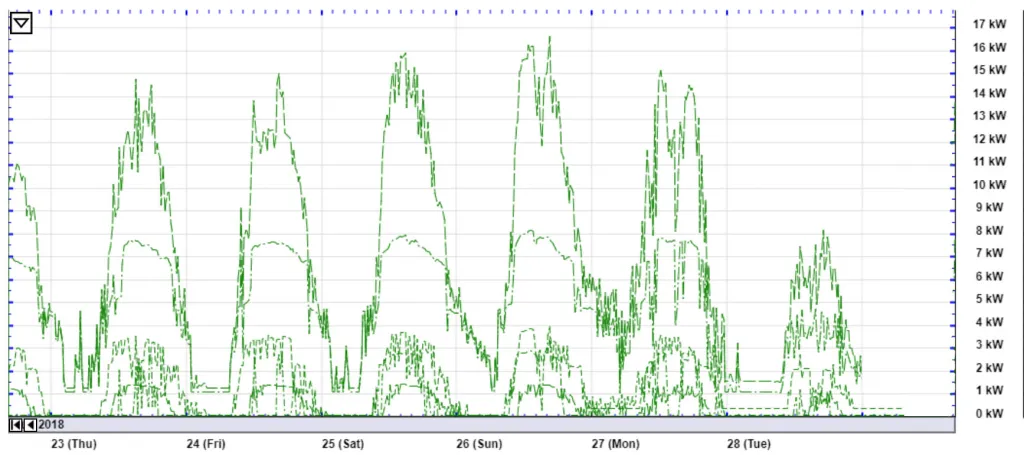
The outdated thermostats were replaced with advanced models capable of running on specific schedules tailored to their respective zones. These new thermostats also allow for restrictions on local changes, or the option to set a temporary setpoint that automatically reverts to the permanent one. In the graph below, you can see that before the system was installed, the kW consumption would spike as high as 17 kW. After the installation on Tuesday, the peaks dropped to just 8 kW—a reduction of more than half!
Refrigeration
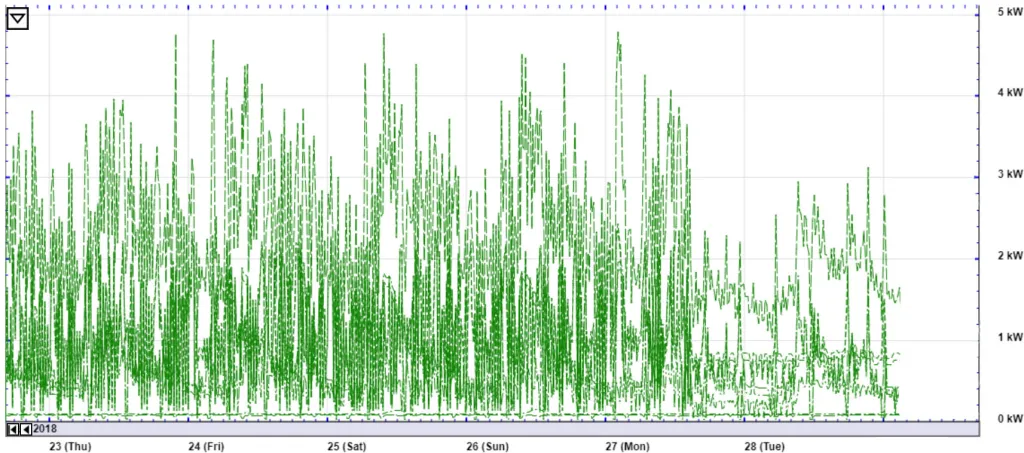
We also installed our adaptive controller on their walk-in refrigeration and freezer units. Unlike traditional systems that defrost a set number of times per day, our adaptive controller defrosts on demand, as needed. On average, this reduces the number of defrost cycles by 70%. The controller monitors the environment through sensor readings, optimizing the defrost schedule to minimize energy use. This not only cuts energy consumption but also improves food quality by exposing it to fewer defrost cycles. In the graph below, you can see that before the eViewIoT Energy Management System was installed, energy consumption peaked at nearly 5 kW. After the installation on Tuesday, peak consumption dropped to about half of that.
We see results like these consistently across the thousands of locations where we have eViewIoT installed. While our primary goal is to help you save energy and reduce your carbon footprint, that’s just the beginning of what we offer to restaurants and convenience stores. We also prioritize food safety and operational efficiency, ensuring that your business runs smoothly. Talk to one of our energy experts today to learn how we can enhance your operational efficiency and food safety—all while significantly cutting your energy costs.